New PEN America Report Finds Nonfiction a Growing Target for Book Banners
“The content of these books that are disappearing speaks volumes about both the stories, identities, and facts that are being suppressed, and about the political and cultural attack on public education across the U.S.,” the report states.

In a new report, PEN America found that censorship of nonfiction is on the rise in U.S. schools across an array of subjects, from history and health to biographies and memoirs.
The report, Facts & Fiction: Stories Stripped Away by Book Bans, released on May, 7 offers a detailed analysis of the content of some 3,743 unique titles that were removed from school libraries and classrooms from July 1, 2024 to June 30, 2025, finding that 29% of banned titles were nonfiction—more than double the number of nonfiction titles banned in the previous years.
"This latest trend shows an embrace of anti-intellectualism, undermining public knowledge by devaluing education and expertise," said Kasey Meehan, director of PEN America's Freedom to Read program, in a statement. "It is another example of how censorship sweeps broadly, leading to removals of all kinds of books, in its efforts to sow fear and distrust in our public education system."
PEN America officials said "activism" was the most commonly banned topic within nonfiction titles, with 52% of the 1,102 nonfiction titles banned containing “themes of activism and social movements.” Another 39% of banned titles related to empowerment and self-esteem.
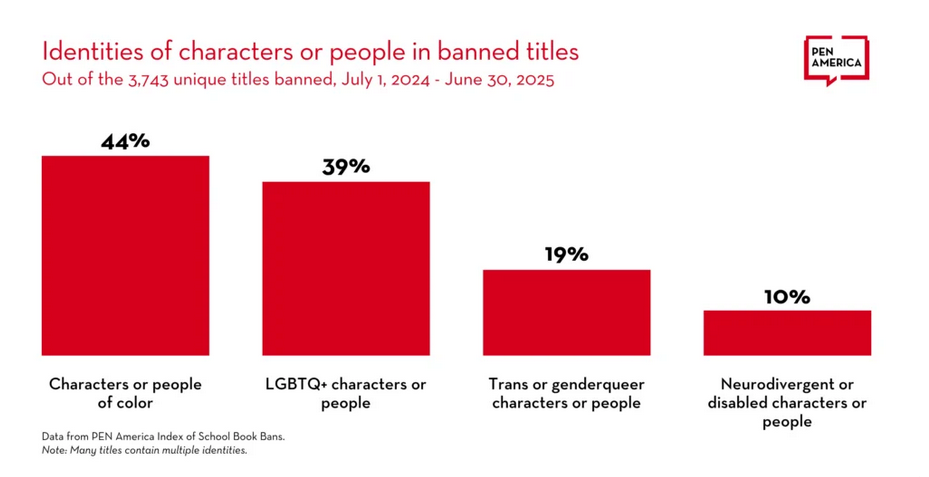
Furthermore, the report found that literature featuring “marginalized identities and communities” continued to be the most targeted: 44% of censored books feature BIPOC characters; titles focusing on LGBTQ+ themes represented 39% of banned books; 19% of censored books included transgender characters; and characters with physical disabilities and cognitive variations (autism, attention deficit disorders, dyslexia) made up 10% of the targeted books.
The report also further debunked myths about books with “sexual content,” which have been a frequent target of the current surge in book bans dating back to 2021. More than a third of the books removed contained some sexual content but claims that the books contained "pornographic" or "obscene" material is a gross mischaracterization, the report states.
“The content of these books that are disappearing speaks volumes about both the stories, identities, and facts that are being suppressed, and about the political and cultural attack on public education across the U.S.,” the report states. “That attack on public education restricts the freedom to read for young people of this country, harming their abilities to see themselves and others, be challenged, and explore their world.”
The full report is available for download here.