Publishers and Authors Sue Meta, Alleging ‘Massive’ Copyright Infringement Behind Its Llama AI Service
The class action lawsuit, filed in New York, accuses Meta—and its founder and CEO Mark Zuckerberg personally—of building its Llama AI service with unauthorized copies knowingly sourced from illegal pirate sites.

In a long-anticipated move, a group of major publishers and authors in the U.S. has filed a massive copyright infringement lawsuit over the unauthorized use of copyrighted works used to develop a popular AI service—the first AI-related lawsuit brought directly by book publishers in the U.S.
Organized with the help of the Association of American Publishers, five major academic, professional, and trade publishers (Elsevier, Cengage, Hachette, Macmillan, and McGraw Hill), along with bestselling author Scott Turow, filed the putative class action lawsuit against Meta and its founder and CEO, Mark Zuckerberg on May 5 in New York, alleging the “willful infringement of millions of textual works” used in the training of Llama, Meta's large language model.
Turow is also a named plaintiff in a 2023 Authors Guild class action lawsuit against Open AI.
The complaint accuses Meta—allegedly at Zuckerberg's direction—of scraping, torrenting, and downloading unauthorized copies of millions of copyrighted works from known illegal pirate sites to develop its Llama (short for Large Language Model Meta AI) generative AI system.
“Defendants’ infringement displaces legitimate sales of publications by downloading and torrenting copies from unauthorized sources. It usurps the existing and growing AI licensing market by copying Plaintiffs’ and the Class’s works into Llama’s training set without permission or compensation. Further, Llama’s wide-ranging and varied outputs dilute the overall market and substitute for the copyrighted works on which Llama trained,” the complaint states.
“If left unaddressed, Meta’s actions will cause broad and lasting damage to the publishing industry and authors and weaken the incentive to create that is at the core of the Copyright Act,” the complaint continues. “These facts are not a referendum on AI technologies, but rather their greedy and irresponsible deployment.”
The suit, Elsevier Inc. et al. v. Meta Platforms, Inc. and Mark Zuckerberg, seeks to establish a class made up of those whose works have been infringed by Meta, and asks the court for an order declaring that Meta’s practices violate the Copyright Act; an injunction barring future infringement; monetary damages up to the maximum amount allowed by law; an “accounting of the training materials, training methods, and known capabilities” of Meta’s Llama models; and the destruction of all infringing copies in Meta’s possession.
An AI 'Arms Race'
The publishers’ complaint adds to the long list of actions filed in the U.S. Courts, which now reportedly sits at over 100.
It also comes as two of the publisher plaintiffs—Cengage and Hachette—await a ruling on their bid to intervene as class representatives for publishers in another case, In Re Google Generative AI Copyright Litigation, a 2023 copyright infringement lawsuit that accuses Google of using unauthorized copies to train its Gemini AI service.
 Andrew Richard Albanese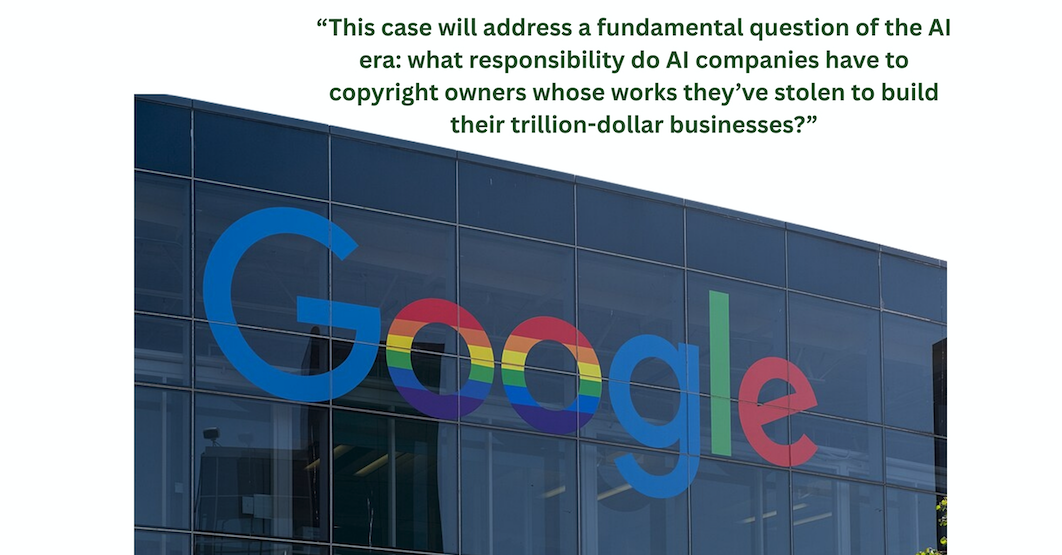
The suit also comes just days before a May 14 final fairness hearing for the $1.5 billion settlement in Bartz v. Anthropic.
Thus far, such copyright lawsuits over AI development have delivered mixed results.
In the Anthropic case, for example, judge William Alsup in June 2025 found that Anthropic's unauthorized use of copyrighted books to train its Claude AI system was fair use. But the judge also found that the company's decision to keep millions of unauthorized downloads for a permanent research library was not, a finding that ultimately led to the massive settlement.
Nicholas Garcia
Also in June 2025, in Kadrey v. Meta, an author-driven lawsuit, judge Vincent Chhabria similarly found AI training on copyrighted works to be fair use. Chhabria, however, chided the plaintiffs’ lawyers for their presentation of the case and suggested that there was likely an issue with “market dilution”—that is, the possibility that AI-generated works could disrupt the marketplace for works created by human authors—that should have been argued.
Notably, the Kadrey case contains several nearly identical facts and claims against Meta over the use of works from pirate libraries, with Chhabria largely rejecting the plaintiffs’ claims that the use of unauthorized copies from notorious pirate sites was clearly infringing.
Authors Alliance
At the very least, the publishers’ latest suit benefits from having both Alsup and Chabbria’s previous rulings in hand. In their complaint, lawyers for the publishers embrace Chhabria's "market dilution" theory, suggesting that Llama’s outputs are already disrupting the marketplace for human-authored works, and that Meta employees “attempted to conceal” their use of shadow libraries, which emails suggest they understood to be legally questionable, the complaint argues.
“Meta’s copying of these literary works was neither incidental nor accidental,” the publishers’ suit claims. “It was a calculated decision driven by the need to appropriate the expressive value of copyrighted written works to produce an AI system capable of generating outputs that directly compete with literary works written by human authors.”
The complaint goes on to describe Llama as “an infinite substitution machine” that threatens to displace the Class’s copyrighted works in multiple ways, including by outputting “verbatim and near-verbatim” copies; by paraphrasing and summarizing; by generating low-quality knockoffs and imitations; by “flooding the market with AI-generated works that dilute the overall market” for literary works; and by producing “unauthorized derivatives.”
The publisher's proposed class is broad, including copyright owners of everything from novels and poems to nonfiction works and scientific journal articles (the Kadrey suit, meanwhile, focuses on fiction writers). Meta’s LLM, the complaint points out, is capable of generating travel guides on demand, for example, as well as summaries of books, academic research, and study guides. It is also capable of creating "knockoffs" of the popular novels it trained on, including, the complaint alleges, an “passable” imitation of the opening chapter of Sylvia Day’s One With You.
“The risk of Llama competing with texts written by human authors for sales and attention is not theoretical—it is happening,” the complaint states. “These AI-generated books are already flooding the world’s largest book marketplace, Amazon, in volumes that materially displace human-authored works. AI-produced titles have saturated Amazon’s Kindle ecosystem, and commentators have described the flood of AI-generated books on Amazon as a persistent, years-long crisis. They also devalue the original works on which the AI model was trained.”
Walking the AI Line
In a statement, Meta officials noted that courts have found that “training AI on copyrighted material can qualify as fair use," and vowed to fight this lawsuit aggressively.”

In a release of their own, the plaintiffs slammed Meta’s conduct while also endorsing the promise of AI technology more broadly. "The Association of American Publishers enthusiastically supports this important class action which abundantly illustrates that Meta made calculated decisions to enrich itself with literary properties that it did not create and does not own, when instead it could have partnered with publishers and authors,” said AAP president and CEO Maria A. Pallante. “Meta's mass-scale infringement isn't public progress, and AI will never be properly realized if tech companies prioritize pirate sites over scholarship and imagination."
"We believe artificial intelligence has had and will increasingly have an important role in education and learning. But we also believe in protecting the foundational intellectual property rights of human authors around the globe who create original content,” said McGraw Hill CEO Philip Moyer.
"Meta, and Mark Zuckerberg, chose not to compensate rights holders for the use of their works and, instead, downloaded pirated works to train their models,” said Hachette CEO David Shelley. “Sanctioning such a wholesale theft would be devastating to all authors and to the entire publishing industry.” Macmillan CEO Jon Yaged said it was "unconscionable that one of the world's most valuable companies chose to steal millions of works from creators for its own self-enrichment."
Chairman YS Chi said that Eslever officials “believe deeply in the promise of AI,” but stressed that the technology must be built “on a foundation that respects authors, upholds trust, and sustains the global research and healthcare ecosystem.” Cengage CEO Michael Hansen agreed, calling AI “an immense opportunity,” but adding that “strong intellectual property protections” are fundamental.
“The path forward is about building and scaling AI technologies responsibly" Hansen said, "ensuring that the value created is shared fairly, and that the integrity of published content remains strong for audiences everywhere."